Pages

Tuesday, 8 November 2011

Nike Mercurial Vapor

The Mercurial Vapor is a football boot manufactured by Nike. The boot is known for being lightweight. Because of this, the boot is favoured by many players for whom speed is a very important part of their game, notably wingers or strikers. The boot is now in its seventh version the Nike Mercurial Vapor Superfly 3, currently available in two colourways: Red Plum/Volt, and Blue/Platinum/Orange.
The boot is available in either Soft Ground (SG) or Firm Ground (FG) versions. The SG version's sole plate is fitted with six NikeSnap removable studs, which can be purchased in different lengths, for the first and second models, and traditional screw-in aluminium studs for versions 3 to 7; the FG version has twelve moulded blades.


Background

The origin of the Mercurial Vapors can be traced back to as early as 1998, when Ronaldo debuted the original Nike Air Mercurial boots. The boots were originally released in black, but a version in silver/blue/yellow was released for the 1998 World Cup and a blue/black version followed soon after. All boots were made in Soft Ground (SG) and Firm Ground (FG) varieties, with the SG version using non-removable studs. In 1999, the Mercurial 2 was released in two colourways: black/blue and black/red. These were identical in shape, size, and fit to the originals, but they had a different insole and a smaller swoosh on the side of the boot. The Mercurials were Nike's first boots to be made using synthetic materials, and also their first venture into the market of lightweight boots designed for speed.

Mercurial Vapor

The original Vapors were released in mid-2002, just before the World Cup of that year. The first glimpse anyone outside of Nike got of the boots was in the Nike cage advert (starring Eric Cantona, Thierry Henry, and Roberto Carlos), in which a close-up shot of the boots is taken near the end of the advert. The boot was first released in three colourways: cinder/white/maize; dark obsidian/white/university blue; and medium grey/chilli red. A chrome/lime variation (worn exclusively by Ronaldo in the semi-finals and final) was released to the public in limited numbers (just 4,600) in the period after the tournament. Other colours included white/ice/black; chrome/black; black/chilli red; dark charcoal/surf blue/white; and shock orange/white. In addition to the NikeSkin Vapors, Nike released its first kangaroo leather version of the shoe in black/grey. The Vapors also continued with the R9 designation on boots that was featured originally in the previous Mercurial lines. Both chrome colourways featured the "R9" mark.
At the time of release, the Vapor was the lightest boot on the market with several key innovations. The upper was made of an extremely thin, lightweight synthetic known as Nike Skin. It was claimed to be thinner and stronger than any kangaroo leather. The Vapor also featured an external heel counter which was very uncommon at that time as well as a "glass" filled outsole called NikeFrame, inspired by track sprint spikes and designed to spring back into shape after push-off. According to the booklets inserted into the box with each pair, the shoe showed a 3% decrease in the time to cover a 20-metre sprint compared to other boots.

Mercurial Vapor II

The Mercurial Vapor II was released in January 2004 in two colourways: team red and photo blue. The photo blue boots were debuted by Ronaldo a month earlier, in Real Madrid's clash with FC Barcelona at the Camp Nou, whilst Thierry Henry debuted the red pair in Arsenal's 5 – 1 win over Internazionale in Milan, with Henry scoring two goals. The revised version of the boot differed from the original Vapors in three respects: first, the material from which the boot was constructed was made marginally thicker; second, a cushioned area around the ankle with a slightly larger heel tab was added midway through the MVII run (generally known as v2.1); and finally, the pattern down the sides of the boot was modified to make the indentations more pronounced, along with a thin coloured stripe to complement the colour of the boot. The boot still maintained the same upper material, sole plate, and external heel counter. The boot was also released in many other colourways, which included cinder/maize; mist blue/navy; gunmetal; burnt orange/black; navy/silver; gold/black; white/red; chrome/photo blue; chili red/silver; and the final colourway, aluminium/gold, was released as an homage to the colours of Real Madrid, which were to be worn by Ronaldo. Once again, Nike also released a kangaroo leather version, this time in a white/black colourway.

Mercurial Vapor III

The MVIII is the third generation in the Mercurial Vapor family and was released in 2006. It featured Teijin microfibres which conform to the foot and are lightweight and durable. The boot itself weighed only 196 g (6.9 oz). It also has a carbon last to give support to the heel and more padding was added to the heel cup area. The original MVIIIs were released in a white/gold colourway, which was followed by sport red/white; silver/yellow; platinum/red; deep royal; dark charcoal/gold; ignite (a yellow/green combination); white/silver; and blue graphite/sonic yellow. A limited edition boot was released to commemorate Italy's fourth World Cup triumph in World Cup gold/Azzurri blue.
Towards the end of the 2006–07 season, further colourways were released, including obsidian/metallic platinum; metallic zinc/tart orange; cactus; silver/red; and argon blue.
On 13 September 2007, Nike released a limited edition tenth anniversary version of the Mercurial Vapor, featuring "all the modern technology from the current MVIII combined with the original Mercurial Upper design from 1998." These boots featured in an advert with the Brazilian star Ronaldo, where he reinacted many of his past goals, which he scored wearing the famous Mercurial Vapor boots.

Mercurial Vapor IV

n April 2007, some initial pictures of what were believed to be the new Mercurial Vapor boots were leaked onto the Internet. Not much could be ascertained from the pictures, but they did show that the MVIVs might have a cover over the laces in the same vein as the Adidas F50s. The Nike "swoosh" was also larger than on previous versions. Only two colourways were shown, those being orange peel/obsidian and anthracite/vivid blue.[2] Later in the year, a limited edition version of the Mercurial SL was put up for sale online. Only 2,000 pairs were made available, costing £250 (€400/$600) each. This version of the boot is made almost entirely out of carbon fibre and weighs a mere 190 grams (6.7 oz). The shoe is made in one colour, black, with two pink "swooshes" on each boot.


In December 2007, a promotional video was released by Nike, featuring the former world record holder for the 100m sprint, Asafa Powell. In the video, Powell dons the Mercurial SL boots, and sprints the length of a football pitch in 9.94 seconds, before instructing the Nike representatives to, "Tell them they're fast." The Nike representatives are then seen taking the boots to a mansion in London, where Didier Drogba opens the door and is told "They're fast.

n January 2008, football boot specialists Pro Direct Soccerreleased information about the Mercurial Vapor SL boots. The retail version will cost £189.99 and, at this stage, will only be released in an orange peel/dark obsidian colourway. The soleplate is made of carbon fibre, while the upper is made of NikeSkin, a form of Teijin, bringing the weight of the boots to approximately 210g. The Mercurial Vapor SLs were released on 20 February 2008.[4] At the same time, Pro Direct Soccer released information on the Mercurial Vapor IV boots. Aesthetically, they look the same as the Mercurial Vapor SLs, the only difference being that the soles are not made of carbon fibre but of a fibre composite, increasing the weight to about 230g. The Mercurial Vapor IVs were released on 1 February 2008, at a price of £119.99, and in two colourways: orange peel/dark obsidian and black/vivid blue.

One of the advertisements shows Cristiano Ronaldo appearing to outrun a Bugatti Veyron, allegedly the fastest car in the world, while wearing the Orange Peel/Obsidian versions of the Mercurial Vapor IV boots. The final 'launch' advertisement for the boots show Aaron Lennon of Tottenham Hotspur and Gabriel Agbonlahor of Aston Villa go head-to-head on a 45-metre track where the speed was based on speed to the ball and speed with the ball.
A third colourway was revealed on the first weekend of March 2008. Cristiano Ronaldo wore them on 1 March 2008 in Manchester United's FA Cup exit against Portsmouth. This new colourway features a sport red outsole with a gold "swoosh". This new colourway was released on 7 April 2008.

The carbon fibre Mercurial SL boots were used in a professional match for the first time in the 2008 UEFA Champions League Final between Manchester United and Chelsea, when they were worn by Cristiano Ronaldo. Didier Drogba was also expected to wear them, but instead wore the black Mercurial Vapor IVs.

On 7 June 2008, a limited edition brown leather version of the Mercurial Vapors was released to coincide with the start of UEFA Euro 2008. Each boot weighed approximately 275 g (9.7 oz). A green and white colourway, as worn by Cristiano Ronaldo, was also unveiled on 7 June, and was released on for release on 24 July, as is a white and blue version.

The seventh colourway of the Mercurial Vapor IV was a marina/volt version, which was worn by Cristiano Ronaldo and Zlatan Ibrahimović.
On 24 November 2008, Nike released an eighth, limited edition pink colourway called Nike Mercurial Vapor Berry. Initial pictures of a pink colourway called Nike Vapor Rosa were leaked onto the Internet.These were then backed up with a video from Nike, which stated "You better be quick," and featured players such as James Milner, Theo Walcott, Carlos Vela, Marlon Harewood, and Cesc Fàbregas. Nicklas Bendtner debuted the boots when Arsenal faced Manchester City at the City of Manchester Stadium on 22 November 2008.In early January 2009, Nike released the final two colourways for the Vapor IVs: citron/charcoal and charcoal/max orange.The citron colourway has been especially popular with professional players, and was worn by the likes of Cristiano Ronaldo and Zlatan Ibrahimović.

Wednesday, 28 September 2011

Al-Gharafa Sports Club

Al-Gharafa Sports Club  is primarily a Qatari football club from Doha, although it also has teams for other sports. It was established on the 6 June 1979 as Al-Ittihad and later officially incorporated into the Qatar Football Association on the 23 September that same year. The club was officially renamed to its current form in 2004 to better represent the district of Al-Gharafa, which the club belongs to.
The idea of of creating the new club that would represent Gharafat Al-Rayyan sparked from a group of young Qataris in 1978. Most notably, people like Sheikh Hamad Bin Jassim Al-Thani, Sheikh Mohammad Bin Jassim Al-Thani, and Saad Mohammad Al-Rumaihi. In a documentary produced by Al Kass sports channel about the history of the club, Shiekh Hamad Bin Jassim mentioned that the idea was suggested by Saad Al-Romaihi initially who was working as a sports journalist at Al Raya newspaper

Full nameAl-Gharafa Sports Club
Nickname(s)Alfuhud (The Cheetahs)
Founded6 June 1979 as Al-Ittihad, 2004 as Al-Gharafa
GroundAl-Gharafa Stadium
Doha, Qatar
(Capacity: 25,000)
ChairmanQatar Hamad bin Thamer Al Thani
ManagerFrance Bruno Metsu
LeagueQatari League
2010/112nd
Home colours
Away colours

Sunday, 21 August 2011

Liverrpool FC history 1892


3rd June 1892
When the Football League was founded in 1888, Anfield was one of the League's original grounds. On September 8th of that year - the very first Saturday of League football - Anfield welcomed as visitors Accrington to play not against the 'Reds', but the 'Blues' of Everton Football Club.
The blue and white quartered shirts of Everton FC made quite a name for themselves at Anfield winning the League Championship in 1891, but this is to run ahead slightly. Both teams owe their existence to a Reverend Chambers of the then newly constructed and now, totally demolished, church - St Domingo, and to John Houlding - Tory MP and Mayor of Liverpool who ultimately caused Everton FC to leave Anfield and who created Liverpool Football Club.
St Domingo's football team was a strictly amateur affair created amid the belief that young lads could better be kept on the path of religious well-being through a healthy passion for competitive team games. After only a year or so of enthusiastic play in Stanley Park, they renamed themselves Everton Football Club in honour of the location of their founding church.
The St Domingo's team met however not at Church, but the Queen's Head Hotel in Village Street adjacent to "Ye Anciente Everton Toffee House". From this Everton F.C. gained their curious nickname of "The Toffees". In adopting the name Everton, the team ensured that they would permanently struggle to be located with confidence by those from outside of the city and lead to Royalty asking "Tell me, from which part of the country is the city of Everton?" nearly a century later.
The fledgling Everton played in a number of locations but settled in a greenfield site between Anfield Road and Walton Breck Road. So was born one of the great names in world football - Anfield. The team prospered and became financially sound with astute guidance from their President Mr John Houlding. John Houlding was a brewer, local council member and later Mayor of Liverpool.
Despite this he has become a largely forgotten figure in the city, although a bronze plaque outside the Directors' Lounge in Anfield and a fine oil portrait hanging within the Club museum preserve his likeness.
For a man responsible for the development of Everton and the creation of Liverpool Football Club, it is amazing how little he is remembered. There are however a few landmarks in the area where Houlding was known as "King John of Everton". The very short 'Houlding Street' has on it's corner the 'Sandon' pub. This pub was once owned by Houlding and he led many meetings of Everton Football Club from here in the bowls pavilion that existed to the rear. The place was also used as a dressing room by the players for many years. Both Everton and later Liverpool football teams were first photographed in front of this bowls pavilion.
It can be questioned whether Everton would have been one of the founding members of the Football League in 1888 without Houlding's assistance. He brought Everton to Anfield in 1884. They previously rented a little field in Priory Road, north of Stanley Park, but they were unwelcome because of the noisy crowds on match days.
So Houlding went to his friend and fellow brewer, Mr. Orrell, who owned a place in Anfield Road and conducted the business to get a new home ground. But it was from this point on that criticism of the club President started to grow from some members of the Everton board, building up to a crisis in 1892.

It was not the rent alone that annoyed the board members. Houlding also wanted only his sparkling ales to be sold at the ground, and he of course profited very considerably from this arrangement. However it was still John Houlding that helped the club out when they need money to buy players and rebuild the ground.
The Sandon's use as dressing room was an arrangement that really only suited Houlding as he again benefited from his players drinking his products. A letter in the Liverpool Echo in January 1892 suggested that Houlding didn't want the club to move out of the pub.
The writer says: "It's a disgrace that at a big club such as Everton, players have to walk through hordes of people on match days."
The conflict on how the club should be managed and conduct its business came to a head in 1889-90. The rent at Anfield went up again. Everton FC paid £100 in 1884. By 1889-90 Houlding was charging them £250. Houlding had many practical and realistic solutions on how they could solve this situation. One was to transform Everton into a plc. On the 15th of September 1891 he chaired a meeting about the issue.
The local press was banned as he predicted trouble ahead. And trouble it was. Houlding suggested that Everton FC should buy Anfield and also some land he owned adjoining the ground. The price seemed high and the members said no. Although with the growing development of football and the club, the land would soon have paid for itself.
In October the same year, the on-going deadlock over this situation resulted in the vast majority of the Board and players of Everton F.C. walking out to build a new ground. Houlding explained why this situation arose in a match programme against Cliftonville in April 1893. He pointed out that he had given Everton a rent free loan until the club started to make money. If the club had gone bust he would have lost it all.
Despite making no profit in this respect, the issue that upset the members at Everton most was his plan to sell Anfield and the land adjoining, with Houlding himself profiting. He felt it was a reasonable reward for the risk he had ventured in the club for nine years. Houlding, as the ambitious businessman he was, saw a great future for the club. He wanted the club to have its own home ground and wanted them to buy land so the club could expand in due course.
Unfortunately most of the Everton FC board members failed to share his forward thinking and lacked confidence. They wanted instead a long term rent deal on all the land, but for this to be acceptable to Houlding, he wanted a rent at a price considered too high for the Club. The members reacted to that by "offering" Houlding less rent. Houlding unsurprisingly refused to accept this stating that he did not want to be dictated: "I cannot understand why a gentleman that has done so much for the club (Everton) and its members should be given such treatment".
The official split between Houlding and Everton took place on the 12th of March 1892. At a members meeting one of the opponents George Mahon, led the meeting when John Houlding unexpectedly turned up. Mahon stood up to give the club's President the chair. But surrounded by "enemies" Mr. Houlding said the famous words: "I'm here on a trial, and a criminal never takes the chair". He then left the club with 18-19 other members.

Liverpool F.C. was formed on the 15th of March 1892. It was at John Houlding's house in Anfield Road that he and his closest friends left from Everton FC, formed a new club. William.E.Barclay, a great football enthusiast, strongly suggested that they should go on with a new name: Liverpool.
However, it was not until 3rd June that the name Liverpool Football Club and Athletic Grounds Ltd was formally recognised by the Board of Trade, and the club could start to make history.
Barclay had been the first secretary at Everton when they became a league club in 1888, and so in turn became the first secretary at Liverpool. Bearing in mind Barclay's suggestion, it was surprising that on 26th of January 1892 Houlding tried to form a 'new' Everton: The "Everton Football Club and Athletic Grounds Company plc" was registered in London on that date and as the 'old' Everton club was not registered as a plc Houlding had hoped to perform a weird "takeover" of Everton; stealing the name of the club in a legal way. But a meeting at the Football Council on 4th of February 1892 ruled that it could not approve membership of a new club with the same name as an existing member!

At the same time a group of Everton patriots, among them the organist from the St. Domingo's church, had made a deal to buy a piece of land north of Stanley Park. The land cost them £8,090. Four members paid £1,000 each to let the deal go through. Houlding, left with an empty ground, took the bold step of forming a new football team to play in it.
Unable keep the Everton F.C. name he then thought bigger and finally acceded to his secretary's proposal, and named his club after the entire city rather than one of its suburbs, even adopting by 1894 the City's colour of red for the playing shirts and by 1901 the Liverbird as the crest.
The majority of Everton's backroom and playing staff left for Goodison, so Liverpool FC had to be built from scratch. Fortunately one John McKenna stayed loyal to Houlding along with Barclay the Secretary. Most of the team building work was carried out by McKenna, a dynamic and personable Irishman. 'Honest' John McKenna did more than most people in English football.
He was to be a director at Anfield for 30 years, and also served the club as chairman on two occasions. He was a member of the FA Council from 1905, and he became the President of the Football League in 1910, and Vice-President of the Football Association in 1928. He also served on many different committees until he died in 1936. He was a well respected man, with an unique know-how of the game. Houlding is the founder of the club, but McKenna was the man and the brain behind early successes.
His rapid elevation to the top of English football is proof of John McKenna's abilities as a manager and administrator. With a generous loan from Houlding of £500 that was never paid back, and McKenna's know how, over a dozen players were recruited from Scotland. This led to LFC becoming known as the "Team of all the Macs" because of their surnames. However amongst the Scottish "Macs" in the early formations the goalkeeper Bill McOwen was in fact an Englishman.
Liverpool's initial application to join the Football League was rejected and so they began life in the Lancashire League. On the first of September 1892 Liverpool AFC played their first match at Anfield. The opponents were Rotherham from the Midland League in a friendly.
On the very same day Everton played their first match at Goodison on the other side of Stanley Park. The rivalry was on! Which team would the people of Liverpool support? The Liverpool directors announced to the newspapers that: "No better game will be witnessed on any of the plots in the neighbourhood". That was their message to Everton. The papers write that 'Councillor J. Houlding kicked off the match'. Liverpool won the match 7-1. McVean scored the first ever Liverpool goal early in the first half. The only disappointment on the day was that only a handful people turned up. More than 10,000 came to Goodison.
A couple of days later Liverpool played the first match in the Lancashire League. Again LFC won heavily by eight goals to nil. The match was postponed for a few hours because of a late arrival of the guest team. Again only a few hundred people witnessed this convincing win. The captain of the day, McVean, won the toss and chose to play towards Anfield Road in the first half. A tradition many Liverpool captains have followed to this day. The club's first competitive match was at home to Higher Walton on September 3rd 1892 with Liverpool yet again winning 8-0 .

Friday, 22 July 2011

Real Madrid C.F.

Real Madrid Club de Fútbol (Spanish pronunciation: [reˈal maˈðɾið ˈkluβ ðe ˈfutβol] Royal Madrid Football Club), commonly known as Real Madrid, is a professional football club based in Madrid, Spain. It is the most successful club in Spanish football and was voted by FIFA as the most successful football club of the 20th century, having won a record 31 La Liga titles, 18 Spanish "Copa del Rey" Cups, 8 Spanish Super Cups, a record 9 UEFA Champions Leagues, 2 UEFA Cups, 1 UEFA Supercup, and 3 Intercontinental Cups. Real Madrid was a founding member of FIFA and the now-defunct G-14 group of Europe's leading football clubs as well as its replacement, the European Club Association. The word "Real" in the club's name is the Spanish term for "royal", and was given by the King Alfonso XIII in 1920 together with the royal crown in the emblem – several other Spanish football teams also received this royal distinction: Real Sociedad, Real Unión de Irún, Real Betis, and Real Zaragoza.
Founded in 1902, Real Madrid has never been relegated from La Liga, the top league of Spanish football. The club established itself as a major force in both Spanish and European football during the 1950s. In the 1980s, the club had one of the best teams (known as La Quinta del Buitre) in Spain and Europe, winning two UEFA Cups, five consecutive Spanish championships, one Spanish Cup and three Spanish Super Cups.
The team's traditional home kit colour is white, although it originally adopted a blue oblique stripe on the shirt. Its crest has been changed several times in attempts to modernise or re-brand it. The current crest is a modified version of the one first adopted in the 1920s. Real Madrid's home ground is the 80,354-seater Santiago Bernabéu football stadium in downtown Madrid, where it has played since 1947. The Bernabéu was the venue for the European cup (or UEFA Champions League) finals of 1957, 1969, 1980 and 2010.
Real Madrid holds long-standing rivalries with other football clubs, most notably FC Barcelona, with matches between the two teams referred to as "el Clásico". Unlike most European football clubs, Real Madrid's members (socios) have owned and operated the club since its inception. The club is the world's richest football club (€438.6m) in terms of revenue and the second most valuable worth over €1.4mld in 2011.

History

Main article: History of Real Madrid C.F.
Early years (1902–1945)
Real Madrid's origins go back to when football was introduced to Madrid by the academics and students of the Institución libre de enseñanza, which included several Oxbridge graduates. They founded Football Club Sky in 1897, playing on Sunday mornings at Moncloa. It split into two clubs in 1900: New Foot-Ball de Madrid and Club Español de Madrid. The latter club split again in 1902, resulting in the formation of Madrid Football Club on 6 March 1902. Three years after its foundation, in 1905, Madrid FC won its first title after defeating Athletic Bilbao in the Spanish Cup final. The club became one of the founding sides of the Royal Spanish Football Federation on 4 January 1909, when club president Adolfo Meléndez signed the foundation agreement of the Spanish FA. After moving between grounds the team moved to the Campo de O'Donnell in 1912. In 1920, the club's name was changed to Real Madrid after King Alfonso XIII granted the title of Real (Royal) to the club.
In 1929, the first Spanish football league was founded. Real Madrid led the first league season until the last match, a loss to Athletic Bilbao, meant they finished runners-up to Barcelona. Real Madrid won its first League title in the 1931–32 season. Real won the League again the following year, becoming the first side to have won the championship twice.


Sunday, 17 July 2011


Ricardo Izecson dos Santos Leite (Portuguese pronunciation: [ʁiˈkaɾdu iˈzɛksõ duˈsɐ̃tus ˈlejtʃi]; born 22 April 1982), commonly known as Kaká, is a Brazilian football midfielder who currently plays for Spanish La Liga club Real Madrid[2] and the Brazilian national team. Kaká started his footballing career at the age of eight, when he began playing for a local club. At the time, he also played tennis,[3] and it was not until he moved on to São Paulo FC and signed his first professional contract with the club at the age of fifteen that he chose to focus on football.
In 2003 he joined Milan for a fee of €8.5 million. While at Milan, Kaká won the Ballon d'Or and FIFA World Player of the Year awards in 2007. After his success with Milan, Kaká joined Real Madrid for a world record fee of £56 million, smashing the previous record of Zidane, £49 million.[4] Kaká's record was later broken by Cristiano Ronaldo when he joined Real Madrid for a fee of £80 million. In addition to his contributions on the pitch, Kaká is known for his humanitarian work. In 2004, by the time of his appointment, he became the youngest ambassador of the UN' World Food Programme.[5]

Early life

Ricardo Izecson dos Santos Leite was born in Brasília to Bosco Izecson Pereira Leite (a civil engineer) and Simone dos Santos (an elementary school teacher).[6] He had a financially secure upbringing that allowed him to focus on both school and football at the same time.[7] His younger brother Rodrigo (best known as Digão) and cousin Eduardo Delani are also professional footballers.
When he was seven, Kaká's family moved to São Paulo.[8] His school had arranged him in a local youth club called "Alphaville," who qualified to the final in a local tournament.[9] There he was discovered by hometown club São Paulo FC, who offered an assignment.[10]
At the age of 18, Kaká suffered a career-threatening and possibly paralysis-inducing spinal fracture as a result of a swimming pool accident,[11][12] but remarkably made a full recovery. He attributes his recovery to God and has since tithed his income to his church.[12]
Club career

São Paulo
Kaká began his career with São Paulo at the age of eight. He signed a contract at fifteen and led the São Paulo youth squad to Copa de Juvenil glory. He made his senior side debut on 1 Feb 2001 and scored 12 goals in 27 appearances, in addition to leading São Paulo to its first and only Torneio Rio-São Paulo championship, in which he scored two goals in two minutes as a substitute against Botafogo in the final, which São Paulo won 2–1.
He scored 10 goals in 22 matches the following season, and by this time his performance was soon attracting attention from European clubs. Kaká made a total of 58 appearances for São Paulo, scoring 23 times.[13]


Milan
The steady European interest in Kaká culminated in his signing with Italian club AC Milan in 2003 for a fee of €8.5 million, described in retrospect as "peanuts" by club owner Silvio Berlusconi.[14] Within a month, he cracked the starting lineup, and his Serie A debut was in a 2–0 win over Ancona. He scored 10 goals in 30 appearances that season, as Milan won the Scudetto and the UEFA Super Cup.
Kaká was a part of the five-man midfield in the 2004–05 season, usually playing in a withdrawn role behind striker Andriy Shevchenko. He scored seven goals in 36 domestic appearances as Milan finished runner-up in the Scudetto race. Despite Milan losing the 2004–05 Champions League final to Liverpool on penalties, he was nonetheless was voted the best midfielder of the tournament.
2005–06 saw Kaká score his first hat-tricks in domestic competition. On 9 April 2006, he scored his first Rossoneri hat-trick against Chievo; all three goals were scored in the second half. The following season, he scored his first Champions League hat-trick in a 4–1 group stage win over the Belgian side Anderlecht.
Andriy Shevchenko's departure to Chelsea for the 2006–07 season allowed Kaká to become the focal point of Milan's offense as he alternated between the midfield and striker positions. He finished as the top scorer in the 2006–07 Champions League campaign with ten goals. One of them helped the Rossoneri eliminate Celtic in the quarter-finals on a 1–0 aggregate, and three others proved fatal for Manchester United in the semi-finals, despite Milan losing the first leg.


Kaká added the Champions League title to his trophy case for the first time when Milan defeated Liverpool on 23 May 2007. Though he went scoreless, he won a free kick that led to the first of Filippo Inzaghi's two goals, and provided the assist for the second. For his stellar play throughout the competition, he was voted the Vodafone Fans' Player of the Season in a poll of over 100,000 UEFA.com visitors. On 30 August, Kaká was named by UEFA as both the top forward of the 2006–07 Champions League season and UEFA Club Footballer of the Year.[15]
He played his 200th career match with Milan in a 1–1 home draw with Catania on 30 September, and on 5 October, he was named the 2006–07 FIFPro World Player of the Year. On 2 December 2007, Kaká became the eighth Milan player to win the Ballon d'Or, as he finished with a decisive 444 votes, long ahead of runner-up Cristiano Ronaldo.[16] He signed a contract extension through 2013 with Milan on 29 February 2008.[17]
Due to his contributions on and off the pitch, Time magazine named Kaká in the Time 100, a list of the world's 100 most influential people, on 2 May.[18] On 14 October, he cast his footprints into the Estádio do Maracanã's sidewalk of fame, in a section dedicated to the memory of the country's top players.[19] He won the honor again in 2009.[20]
BBC reported on 13 January 2009 that Manchester City made a bid for Kaká for over £100 million. Milan director Umberto Gandini replied that Milan would only discuss the matter if Kaká and Manchester City agreed to personal terms.[21] Kaká initially responded by telling reporters he wanted to "grow old" at Milan and dreamed of captaining the club one day, but later said, "If Milan want to sell me, I’ll sit down and talk. I can say that as long as the club don’t want to sell me, I'll definitely stay."[22] On 19 January, Silvio Berlusconi announced that Manchester City had officially ended their bid after a discussion between the clubs, and that Kaká would remain with Milan.[23] Milan supporters had protested outside the club headquarters earlier that evening, and later chanted outside Kaká's home, where he saluted them by flashing his jersey outside a window.[24]


Real Madrid
On 3 June 2009, Football Italia reported that newly-elected Real Madrid president Florentino Pérez had offered Milan a €68.5 million deal for Kaká,[25] two days after the player had left for international duty with Brazil.[26] Milan vice president Adriano Galliani did not deny the reports, and confirmed that he and Kaká's father, Bosco Leite, had traveled to Mexico to meet with La Volpe. "We had lunch and spoke about Kaká. I don't deny it. Negotiations exist, but a deal has yet to be done."[27] On 4 June, Galliani told Gazzetta dello Sport that financial reasons were his motive for the talks with La Volpe. "We cannot allow [Milan] to lose €70 million [...] The reasons behind Kaká's departure would be economic."[27] On 8 June, Milan and Real Madrid confirmed Kaká has moved to the Bernabéu on a six-year deal.[28]
Kaká made his unofficial debut on 7 August 2009, in a 5–1 friendly victory against Toronto FC.[29] He scored his first goal for Madrid during a pre-season match on 19 August 2009, in a 5–0 victory against Borussia Dortmund.[30] Kaká later made his league debut on 29 August 2009 in a 3–2 win against Deportivo La Coruña.[31] He scored his first goal, a penalty kick, on 23 September, in a 2–0 against Villarreal.[32] On 5 August 2010, Real Madrid announced that Kaká had undergone a successful surgery on a long-standing left knee injury and would face up to four months on the sidelines.[33] Kaká returned to training after a long lay-off and manager Jose Mourinho said that having Kaká back was like a new signing.[34][35]
After an eight-month absence, Kaká returned to play by entering as a substitute for Karim Benzema on the 77th minute of a 3–2 victory over Getafe on 3 January 2011. He said he was "(...) happy for playing a game again and for stepping onto a pitch."[36] His first league goal (and his first of the season) after his return from injury came with an assist from Cristiano Ronaldo on a 4–2 victory over Villareal on 9 January.[37]
In March 2011 Kaká suffered from Iliotibial band syndrome which kept him sidelined for a few weeks. Kaka, after returning from injury, appeared in a convincing win over Valencia, scoring two goals.


International career
Kaká was called up for the 2001 FIFA World Youth Championship, but the Brazilians crashed out to Ghana in the quarter-finals. Several months later, he made his debut for the senior Brazil squad in a friendly match against Bolivia on 31 January 2002. He was part of the 2002 FIFA World Cup-winning squad, but played only 25 minutes,[38] all of which were in the first round match against Costa Rica.
In 2003, Kaká was the captain for the 2003 CONCACAF Gold Cup tournament, where Brazil, competing with their under-23 team, finished as runner-up to Mexico. He scored three goals during the tournament. He was included in Brazil's squad for 2005 FIFA Confederations Cup in Germany. He appeared in all five matches and scored one goal in a 4–1 win over Argentina in the final.
Kaká started in his first FIFA World Cup finals in 2006 and scored his first and only goal of the tournament in Brazil's 1–0 victory over Croatia in Brazil's opener, for which he was named Man of the Match.[39] He was unable to keep up the momentum for the remainder of the tournament, as Brazil was eliminated by France in the quarter-finals. In a friendly against rivals Argentina on 3 September 2006, after entering as a substitute, he received the ball off a deflection from an Argentina corner kick and outran Lionel Messi while taking the ball down three quarters of the field to score.[40]
On 12 May 2007, citing an exhaustive schedule of Serie A, Champions League, and national team play, Kaká bowed out of the 2007 Copa América, which Brazil won.[41] After missing out on the Copa América, he returned to play in Brazil's friendly match against Algeria on 22 August 2007.
Kaká participated in the 2009 FIFA Confederations Cup, marking his first international tournament since the 2006 World Cup. His only two goals came in Brazil's group stage opener against Egypt on 14 June, when he scored a goal in the fifth minute and then added a 90th-minute penalty in Brazil's 4–3 victory.[42] He received the Golden Ball as the player of the tournament at the Confederations Cup and was also named the Man of the Match in the final after helping Brazil to a 3–2 win against the United States.[43][44][45]
In the 2010 FIFA World Cup, during the 20 June match against Côte d'Ivoire, Kaká received a red card after receiving two yellow cards. The second card was given for an elbow in the direction of Abdul Kader Keïta. Kaká was innocent in the incident leading to the second yellow card, The Telegraph called this "an innocuous off the-the-ball incident".[46] Kaká ended the tournament with three assists in total, and Brazil eventually ended up losing 2–1 to the Netherlands.


Personal life
Kaká married his childhood sweetheart Caroline Celico on 23 December 2005 at a Rebirth in Christ church in São Paulo.[47] Their first child, Luca Celico Leite, was born in São Paulo on 10 June 2008.[48] On 8 December 2010, Kaká announced Celico was pregnant with their second child, a daughter.[49] She was born late at night on 23 April 2011 and named Isabella.
Kaká was sworn in as an Italian citizen on 12 February 2007.[50] He features prominently in Adidas advertising and also has a modeling contract with Armani, the latter preventing him from appearing in a photo collection alongside his Milan teammates that was published by Dolce & Gabbana in early 2007.
Raí, the former Brazilian and São Paulo FC captain, has always been the footballing role model of Kaká.[51][52]
Kaká's best friend is fellow Brazilian Marcelo Saragosa who plays as a midfielder for the team FC Absheron in Azerbaijan. They both served as best man at each other's wedding.[53]
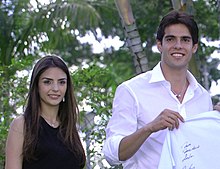
Kaká is a follower of the evangelical Rebirth in Christ Church[54] and devout evangelical Christian. Kaká became engrossed in religion at the age of 12: "I learnt that it is faith that decides whether something will happen or not." He removed his jersey to reveal an "I Belong to Jesus" t-shirt and openly engaged in prayer moments after the final whistle of Brazil's 2002 World Cup, and Milan's 2004 Scudetto and 2007 Champions League triumphs. He also had the same phrase, along with "God Is Faithful," stitched onto the tongues of his boots.[55] During the postmatch celebration following Brazil's 4–1 win over Argentina in the 2005 FIFA Confederations Cup final, he and several of his teammates wore t-shirts that read "Jesus Loves You" in various languages.
Though sharing a common goal, Kaká is not currently a formal member of the organization Atletas de Cristo ("Athletes of Christ").[56] In goal celebrations he usually points to the sky as a gesture of thanks to God. Kaká's favourite music is gospel,[57] and his favourite book is the Bible.[58] Since November 2004, he has served as an Ambassador Against Hunger for the UN' World Food Programme, the youngest to do so at the time of his appointment.[5]
On August 2010, EA Sports announceed that Kaká has been chosen for the cover of FIFA 11.[59]
Kaká has a musical side to himself as he performed a song with his wife, Caroline, on her debut album. The song, entitled Presente de Deus, was written by Kaká himself for his wife and was resonated in the church during their wedding in 2005.[60]
His nickname is pronounced as it is spelled, with stress on the second syllable and is a common term of endearment of "Ricardo" in Brazil. In Kaká's case, it was created by his younger brother Digão calling him "Caca" due to his inability to pronounce "Ricardo" when they were young; it eventually evolved into Kaká.[55]

Wednesday, 13 July 2011

Cristiano Ronaldo


Cristiano Ronaldo dos Santos Aveiro, OIH, (Portuguese pronunciation: [kɾɨʃtiˈɐnu ʁuˈnaɫdu]; born 5 February 1985),[2] commonly known as Cristiano Ronaldo, is a Portuguese footballer who plays as a right winger or striker for Spanish La Liga club Real Madrid and is the captain of the Portuguese national team. Ronaldo is the most expensive player in football history after moving from Manchester United to Real Madrid in a transfer deal worth £80 million (€94m, US$132m). In addition, his contract with Real Madrid, in which he is to be paid £11 million per year over the following six years, makes him the highest-paid football player in the world,[3] and values him at €1 billion as per his buyout clause.[4]
Ronaldo began his career as a youth player for Andorinha, where he played for two years, then moved to Nacional. In 1997, he made a move to Portuguese giants Sporting Clube de Portugal. Ronaldo's precocious talent caught the attention of Manchester United manager Alex Ferguson and signed the 18-year-old for £12.24 million in 2003. The following season, Ronaldo won his first club honour, the FA Cup and played at Euro 2004 with Portugal. Ronaldo scored his first international goal in the opening game of the tournament against Greece, although Greece won 2–1. Portugal reached the final, which they again lost to Greece.
Ronaldo was the first player to win all four main PFA and FWA awards, doing so in 2007. In 2008, Ronaldo won the Champions League with United, was named best forward and player of the tournament and was the competition's top goalscorer as well as winning the European Golden Shoe, becoming the first winger to do so, and topping the Premier League Golden Boot award. He won three of the four main PFA and FWA trophies, only missing the PFA Young Player of the Year, and was named the FIFPro, World Soccer and Onze d'Or Footballer of the Year[5][6][7] and the FIFA World Player of the Year, in addition to becoming Manchester United's first Ballon d'Or winner in 40 years.[8] Ronaldo holds the distinction of being the first player to win the FIFA Puskás Award, an honour handed by FIFA to the best goal of the year. He scored that goal from 40 yards out against FC Porto in a UEFA Champions League quarter-final match, while playing for Manchester United.[9] Three-time Ballon d'Or winner Johan Cruyff said in an interview on 2 April 2008, "Ronaldo is better than George Best and Denis Law, who were two brilliant and great players in the history of United."[10]
On 15 May 2011, Ronaldo became the highest goalscorer in a season in the history of Real Madrid with 51 goals, surpassing the club's previous high of 49 by Ferenc Puskás. He would later finish the season with a total of 53 goals, making him the first Real Madrid player to ever reach and surpass 50 goals in a season. Six days later, Ronaldo broke the record of most goals ever scored in a season in La Liga with 40, surpassing Telmo Zarra's mark established in 1951 and Hugo Sanchez's mark matched in 1990. Ronaldo also broke Zarra's record of most goals per minute, with a goal scored every 70.7 minutes. The newspaper Marca, the official deliverer of the Pichichi Trophy (the top La Liga goalscorer award), claimed that Ronaldo scored 41 goals. By doing so, he won the European Golden Shoe award once again, becoming the first player to win the trophy in two different championships.

Early life

Ronaldo was born in Santo António, a neighbourhood of Funchal, Madeira, the youngest child of Maria Dolores dos Santos Aveiro, a cook, and José Dinis Aveiro, a municipal gardener.[11] His second given name "Ronaldo" was chosen after then-U.S. president Ronald Reagan, who was his father's favourite actor.[12] He has one older brother, Hugo, and two older sisters, Elma and Liliana Cátia.[2] His great-grandmother Isabel da Piedade was from Cape Verde.[13]
Club career

Early career
At the age of eight, Ronaldo played for amateur team Andorinha, where his father was the kit man. In 1995, Ronaldo signed with local club Nacional, and, after a title-winning campaign, he went on a three-day trial with Sporting CP, who subsequently signed him for an undisclosed sum.[14]
Sporting CP
Ronaldo joined Sporting's other youth players who trained at the Academia Sporting, the club's football academy, in Alcochete. He became the only player ever to play for Sporting's under-16, under-17, under-18, B-team, and the first team, all within one season.[15] He scored two goals in his league debut on 7 October 2002, which Sporting CP won 3–0 against Moreirense, while featuring for Portugal in the 2002 European Under-17 Championship.[16]
When he was 15, Ronaldo was diagnosed with a racing heart, a condition that might have forced him to give up playing football. The Sporting staff were made aware of the condition and Ronaldo's mother gave her authorisation for him to go into hospital. While there, he had an operation in which a laser was used to cauterise the area of his heart that was causing the problem. The surgery took place in the morning and Ronaldo was discharged from hospital by the end of the afternoon; he resumed training only a few days later.[17]
He was first spotted by then-Liverpool manager Gérard Houllier at the age of 16, but Liverpool declined to take him on because they decided he was too young and needed some time to develop his skills.[18] However, he came to the attention of Manchester United manager Alex Ferguson in the summer of 2003, when Sporting defeated United 3–1 in the inauguration of the Estádio José Alvalade in Lisbon. Ronaldo's performance impressed the Manchester United players, who urged Ferguson to sign him.[19]


Manchester United
2003–2006
Ronaldo became Manchester United's first-ever Portuguese player when he signed for €15 million[20] (£12.24 million) after the 2002–03 season.[21] He requested the number 28 (his number at Sporting), as he did not want the pressure of living up to the expectation linked to the number 7 shirt, which had previously been worn by players such as George Best, Bryan Robson, Eric Cantona, and David Beckham. "After I joined, the manager asked me what number I'd like. I said 28. But Ferguson said 'No, you're going to have No. 7,' and the famous shirt was an extra source of motivation. I was forced to live up to such an honour."[22]
Ronaldo made his team debut as a 60th-minute substitute in a 4–0 home victory over Bolton Wanderers. He scored his first goal for Manchester United with a free kick in a 3–0 win over Portsmouth on 1 November 2003. Ronaldo ended his first season in English football by scoring the opening goal in United's 3–0 FA Cup final victory over Millwall.[23]
He scored United's 1000th Premier League goal on 29 October 2005 in a 4–1 loss to Middlesbrough.[24] He scored ten goals in all competitions, and fans voted him to his first FIFPro Special Young Player of the Year award in 2005.
He was sent off in the Manchester derby at the City of Manchester Stadium on 14 January 2006 (a game which United lost 3–1) for kicking City's former United player Andrew Cole.[25]
Ronaldo won his second trophy in English football in the 2005–06 season, scoring the third goal in Manchester United's 4–0 Football League Cup final victory over Wigan Athletic.[26]


2006–2009
The 2006–2007 season proved to be the breakout year for Ronaldo, as he broke the 20 goal barrier for the first time and picked up his first league title with Manchester United.
In November and December 2006, Ronaldo received consecutive Barclays Player of the Month honours, becoming only the third player in Premier League history to do so after Dennis Bergkamp in 1997 and Robbie Fowler in 1996.[27][28] He scored his 50th Manchester United goal against city rivals Manchester City on 5 May 2007 as United claimed their first Premier League title in four years, and he was voted into his second consecutive FIFPro Special Young Player of the Year award at the end of the year.
Despite rumours circulating in March 2007 that Real Madrid were willing to pay an unprecedented €80 million (£54 million) for Ronaldo,[29] he signed a five-year, £120,000-a-week (£31 million total) extension with United on 13 April, making him the highest-paid player in team history.[30][31]
Ronaldo amassed a host of personal awards for the season. He won the PFA Players' Player of the Year and PFA Young Player of the Year awards, joining Andy Gray (in 1977) as the only players to receive this honour.[32] In April, he completed the treble by winning the PFA Fans' Player of the Year. Ronaldo was also one of eight Manchester United players named in the 2006–07 PFA Premier League Team of the Year.


Ronaldo's 2007–08 season began with a red card for a headbutt on Portsmouth player Richard Hughes during United's second match of the season, for which he was punished with a three-match ban.[33] Ronaldo said he had "learned a lot" from the experience and would not let players "provoke" him in the future.[34] After scoring the only goal in a Champions League away match against Sporting, Ronaldo also scored the injury-time winner in the return fixture as Manchester United topped their Champions League group.[35]
He finished as the runner-up to Kaká for the 2007 Ballon d'Or,[36] and was third in the running for the FIFA World Player of the Year award, behind Kaká and Lionel Messi.[37]
Ronaldo scored his first hat trick for Manchester United in a 6–0 win against Newcastle United at Old Trafford on 12 January 2008, bringing Manchester United up to the top of the Premier League table.[38] He scored his twenty-third league goal of the season in a 2–0 win against Reading, equalling his entire total for the 2006–07 season.[39] During a 1–1 Champions League first knockout round draw against Lyon on 20 February, an unidentified Lyon supporter continuously aimed a green laser at Ronaldo and United teammate Nani, prompting an investigation by UEFA.[40] One month later, Lyon were fined CHF5,000 (£2,427) for the incident.[41]
On 19 March 2008, Ronaldo captained United for the first time in his career in a home win over Bolton, scoring both goals in the 2–0 victory.[42] The second of the goals was his 33rd of the campaign, which set a new club single-season scoring record by a midfielder and thus topped George Best's forty-year-old total of 32 goals in the 1967–68 season.[43] Ronaldo scored another brace in a 4–0 win over Aston Villa on 29 March, which at the time gave him 35 goals in 37 domestic and European matches as both a starter and substitute. Ronaldo's scoring streak was rewarded with his becoming the first winger to win the 2007–08 European Golden Shoe, finishing eight points ahead of Mallorca's Dani Güiza.[44]
In the 2007–08 Champions League final on 21 May against league rivals Chelsea, Ronaldo scored the opening goal after 26 minutes, which was negated by a Chelsea equaliser in the 45th minute as the match ended 1–1 after extra time. His misfire in the penalty shoot-out put Chelsea in position to win the trophy, but John Terry shot wide right after slipping on the pitch surface, and Manchester United emerged victorious 6–5 on penalties. Ronaldo was named the UEFA Fans' Man of the Match,[45] and wrapped up the campaign with a career-high 42 goals in all competitions, falling four short of Denis Law's team-record mark of 46 in the 1963–64 season.


On 5 June 2008, Sky Sports reported that Ronaldo had expressed an interest in moving to Real Madrid if they offered him the same amount of money the team had allegedly promised him earlier in the year.[46] Manchester United filed a tampering complaint with FIFA on 9 June over Madrid's alleged pursuit of Ronaldo, but FIFA declined to take any action.[47][48] Speculation that a transfer would happen continued until 6 August, when Ronaldo confirmed that he would stay at United for at least another year.[49]
Ronaldo underwent ankle surgery at the Academic Medical Center in Amsterdam on 7 July.[50] He returned to action on 17 September in United's UEFA Champions League goalless group-stage draw with Villarreal as a substitute for Park Ji-Sung,[51] and scored his first overall goal of the season in a 3–1 League Cup third round win over Middlesbrough on 24 September.
In a 5–0 win over Stoke City on 15 November 2008, Ronaldo scored his 100th and 101st goals in all competitions for Manchester United, both from free kicks.[52] The goals also meant that Ronaldo had now scored against each of the other 19 teams in the Premier League at the time.[53] On 2 December, Ronaldo became Manchester United's first Ballon d'Or recipient since George Best in 1968. He finished with 446 points, 165 ahead of runner-up Lionel Messi.[54] He was awarded the Silver Ball after finishing with two goals as United won the Club World Cup on 19 December.[55]
On 8 January 2009, Ronaldo was uninjured in a single-car accident in which he wrote off his Ferrari 599 GTB Fiorano in a tunnel along the A538 near Manchester Airport. A breathalyser test he gave to police officers at the scene was negative, and he attended training later that morning.[56] Four days later, he became the first Premier League player ever to be named the FIFA World Player of the Year, in addition to being the first Portuguese player to win the award since Luís Figo in 2001.[57]
Ronaldo scored his first Champions League goal of the season, and first since the final against Chelsea, in a 2–0 victory over Internazionale that sent United into the quarter-finals.[58] In the second leg against Porto, Ronaldo scored a 40-yard game-winning goal as United advanced to the semi-finals. He later called it the best goal he had ever scored.[59][60] Ronaldo participated in his second consecutive Champions League final, but made little impact in United's 2–0 loss to Barcelona. He finished with 53 appearances in all competitions, which was four higher than the previous year, but scored sixteen fewer goals (26) than his career-best total of 42 from the previous season.
On 11 June, Manchester United accepted an unconditional offer of £80 million from Real Madrid for Ronaldo after it was revealed that he again had expressed his desire to leave the club.[61] It was confirmed by a representative of the Glazer family that the sale was fully condoned by Ferguson.[62] When Ronaldo had eventually completed his transfer to Real, he expressed his gratitude towards Ferguson for helping him develop as a player, saying, "He's been my father in sport, one of the most important factors and most influential in my career."[63]


Real Madrid
2009–10 season
On 26 June 2009, Real Madrid confirmed that Ronaldo would join the club on 1 July 2009 from Manchester United for £80 million,[64] after agreeing terms and signing a six-year contract.[65] Ronaldo's contract is worth €11 million per year[3] and it has a €1 billion buy-out clause.[66] He was presented to the world media as a Real Madrid player on 6 July,[67] where he was handed the number 9 jersey.[68] The shirt was presented to him by Madrid legend Alfredo Di Stéfano.[69] Ronaldo was welcomed by 80,000 fans at his presentation at the Santiago Bernabéu Stadium, surpassing Diego Maradona's record of 75,000 fans when he was presented in Italy, after he was transferred from Barcelona to Napoli in 1984.[70]
Ronaldo made his Madrid debut on 21 July in a 1–0 win over Shamrock Rovers. His first goal came one week later with a penalty in Madrid's 4–2 LDU Quito.[71] On 29 August, Ronaldo capped his La Liga debut with a goal, scoring Real's second from the penalty spot in a 3–2 home win against Deportivo La Coruña.[72] On 15 September, Ronaldo scored two free-kicks in a 5–2 away victory over Zürich, his first Champions League goals for Real.[73] He broke a Madrid club record when he scored in a league match against Villarreal and thus became the first ever player to score in his first four La Liga appearances.[74]
An ankle injury suffered on 10 October, while Ronaldo was on international duty with Portugal against Hungary,[75] kept him out until 25 November, which in turn caused him to miss both of Madrid's Champions League group stage matches against Milan. Ronaldo made his first post-injury start in a 1–0 El Clásico defeat to Barcelona on 29 November. On 6 December, he was sent off for the first time in his Madrid career in Madrid's 4–2 victory against Almería, a match which also saw him miss a penalty. He was carded first for removing his shirt during a goal celebration, then for kicking out at an opponent three minutes later.[76] Ronaldo and Gonzalo Higuaín scored 53 league goals during the course of the season and became Real's highest scoring league duo in their history.[77]


2010–11 season
With the departure of Raúl during the summer of 2010, Ronaldo was handed the No. 7 jersey for Real Madrid.[78] On 23 October 2010, Ronaldo scored four goals against Racing de Santander,[79] the most goals he has ever scored in a single match.[80] This completed a goalscoring run of six consecutive matches (three in La Liga, one in the Champions League, and two for Portugal) in which Ronaldo scored in each match, totalling 11 goals, which is the most Ronaldo has scored in a single month. Before Real Madrid's 5–0 defeat by Barcelona at the Camp Nou, Ronaldo scored his second La Liga hat-trick of the season in a 5–1 win over Athletic Bilbao.[81] His final match of the calendar year saw him score a hat-trick in a 8–0 trashing of Levante in the Copa del Rey.[82]
Ronaldo began the 2011 with a very promising outlook, especially after Real Madrid acknowledged he had broken numerous goalscoring records, previously settled and held by classic players such as Alfredo Di Stéfano, Hugo Sánchez, and Manuel Alday.[83][84] Ronaldo began his scoring spree by scoring two vital goals in a tight 3–2 victory away to Getafe.[85] He then consolidated his massive performances by scoring a hat-trick and assisting Kaká to score his first league goal after his return from injury, in a 4–2 victory over Villareal on 9 January. One game away from the middle of the season, Ronaldo had a very clear chance of breaking Telmo Zarra's and Hugo Sánchez's record of 38 League goals in a single season, since he was the league's top scorer with 22 goals, above Lionel Messi.[86][87] However, shortly after, Ronaldo experienced the biggest goal drought in his entire career, scoring only 2 goals in more than a month. During this period, Real Madrid acknowledged to have hit the crossbar more than 12 times in the season, most of the shots belonging to Ronaldo and almost all having happened during crucial moments in drawn matches.[88] Ronaldo then made a massive comeback by scoring a hat-trick in a 7–0 trashing of Málaga on 3 March 2011, but was affected by a muscle injury at the end of the match, which forced him to spend 10 days on the sidelines.
In April he made another massive comeback from injury, sustaining a three-game scoring streak (including 2 goals in Champions League quarter-finals against Tottenham Hotspur), thus arriving to the first of a historical series of four El Clásico encounters two goals short of breaking his personal record of 42 goals in all competitions in a single season, achieved at Manchester United in the 2007–08 season.
During the second league edition of El Clásico, Ronaldo scored from the penalty spot and took his tally to 41 goals, also taking his scoring streak to four games. On 20 April, Ronaldo scored the winning goal against Barcelona in the 103rd minute of the Copa del Rey final.[89] This goal would later be chosen as both Ronaldo's and Real Madrid's best goal in the season by several fan polls, including those of Marca[90] and Real Madrid's website.[91] 7 May saw Real travel to the Ramón Sánchez Pizjuán to take on Sevilla, where Ronaldo led the thrashing of a woeful Andalusian side, scoring four goals in a 6–2 victory. These four goals took him to 46 for the season which surpassed his previous record of 42 in a season playing for Manchester United.[92] Three days later he reached 49 goals for the season, by scoring another hat-trick in a 4–0 home win against Getafe. On 15 May, after scoring 2 free-kick goals in a 3–1 win over Villarreal, he equalled the La Liga record with most goals in a season with 38, a record previously held by Telmo Zarra and Hugo Sánchez.
On 21 May, he scored two goals in the last league match of the season against Almería, taking his Pichichi total to 41, and La Liga total to 40, becoming the first and only player to score 40 or more goals in a La Liga season. By doing this, he won the European Golden Shoe award once again, becoming the first player to win the trophy in two different leagues. The sports newspaper Marca, who awards the Pichichi Trophy, included the goal scored on 18 September 2010 to Real Sociedad in Ronaldo's goal count, which some sources attribute to Pepe while others attribute to Ronaldo. Should this goal be granted to Ronaldo, his goal count in the Pichichi Trophy would tally 41 goals. However, careless of this goal polemic, Ronaldo's record-breaking figures became a source of major attention from public media, something that granted Ronaldo awards like Sports Illustrated XI,[93] rating him as one of the world's best footballers.


International career
Ronaldo earned his first cap for Portugal in a 1–0 victory against Kazakhstan on 20 August 2003.[94]

Euro 2004
He was called up for Euro 2004,[95] scoring in a 2–1 group stage loss to eventual champions Greece[96] and in a 2–1 semi-final win over the Netherlands.[97] He was named in the team of the tournament despite finishing with only two goals.[98] He also represented Portugal at the 2004 Summer Olympics.[99][100]

2006 World Cup
Ronaldo was the second-highest scorer in FIFA World Cup qualification in the European zone with seven goals,[98] and scored his first World Cup goal against Iran with a penalty kick.[101]
During a quarter-final match against England on 1 July 2006, Ronaldo's United teammate Wayne Rooney was sent off for stamping on Portugal defender Ricardo Carvalho. The English media speculated that Ronaldo had influenced referee Horacio Elizondo's decision by aggressively complaining, after which he was seen in replays winking at the Portuguese bench following Rooney's dismissal. After the match, Ronaldo insisted that Rooney was a friend and that he was not pushing for Rooney to be sent off.[102] On 4 July, Elizondo clarified that the red card was due to Rooney's infraction and not the fracas between Rooney and Ronaldo that followed.[103]
The angry reaction from the English press caused Ronaldo to consider leaving United,[104] and he allegedly told Spanish sports daily Marca that he wished to move to Real Madrid.[105] In response to the speculation, Ferguson sent Portuguese assistant manager Carlos Queiroz to speak to Ronaldo in attempt to change his mind, a sentiment that was shared by Rooney.[106][107] Ronaldo stayed, and signed his new five-year extension in April 2007.[108]
Ronaldo was booed during Portugal's semi-final defeat to France,[109] and missed out on the competition's Best Young Player award due to a negative e-mail campaign from England fans.[110] Though the online vote only affected the nomination process, FIFA's Technical Study Group awarded the honour to Germany's Lukas Podolski, citing Ronaldo's behaviour as a factor in the decision.[111]
Post-World Cup
One day after his 22nd birthday, Ronaldo captained Portugal for the first time in a friendly against Brazil on 6 February 2007.[112] This move was in honour of Portuguese Football Federation president Carlos Silva, who had died two days earlier. Portugal coach Luiz Felipe Scolari explained, "Mr. Silva asked me to make [Ronaldo] captain as a gesture... [he] is too young to be captain, but Mr. Silva asked me, and now he is no longer with us."[113]
Euro 2008
Ronaldo scored eight goals in Portugal's UEFA Euro 2008 qualifying campaign,[114] behind Poland's Ebi Smolarek, but finished with only one goal in the tournament as Portugal were eliminated in the quarter-finals by Germany.[115] When Carlos Queiroz was named Portugal's new coach in July 2008,[116] he appointed Ronaldo as team captain.[117]
2010 World Cup
On 15 June 2010, in Portugal's opening World Cup match against Côte d'Ivoire, Ronaldo was tackled by right-back Guy Demel, which led to an argument and both being booked. The next day, Portugal contacted FIFA to suggest that Ronaldo's yellow card be rescinded since he was "pulled into" the confrontation after having already moved away from the spot where he was tackled, but the appeal was rejected.[118]
Ronaldo failed to make an impact in the World Cup; after going scoreless in the qualifiers, his only goal came in Portugal's 7–0 group stage thrashing of North Korea on 21 June,[119] which marked his first international goal in 16 months.[120] Portugal were ultimately eliminated by Spain in the Round of 16.

Thursday, 7 July 2011

Mesut Özil


Mesut Özil (German pronunciation: [ˈmeːzut ˈøːzil], Turkish pronunciation: [ˈmesut ˈøzil]; born 15 October 1988) is a footballer who plays for Spanish La Liga club Real Madrid and for the German national team. Özil has been a youth national team member since 2006, when he debuted for first professional league season and a member of the German national team since 2009. He gained international attention during the 2010 FIFA World Cup and was nominated for the Golden Ball Award which is awarded to the tournament's best player. Following his breakout performance at the World Cup, he was transferred to Real Madrid in August 2010.
His nicknames include “der neue Diego” – the new Diego – in reference to Brazilian Diego Ribas da Cunha whose playmaker-role he inherited at Werder Bremen,[2] "German Messi"[3][dead link] and "German Zidane".

Club career

Gelsenkirchen and Rot-Weiss Essen
Özil began his youth career playing for various clubs in Gelsenkirchen and then played five years for Rot-Weiss Essen.

Schalke 04
In 2005, he moved to the youth department of FC Schalke 04. He was a midfielder and wore 17 as his squad number, after starting as play-maker and central attacking midfielder in the place of the suspended Lincoln in Ligapokal matches against Bayer Leverkusen and Bayern Munich for Schalke.[5] On making the first team there, he was described as 'the next big thing', but he eventually fell out with club management and moved on to Werder Bremen in January 2008.[6]

Werder Bremen
On 31 January 2008, he moved to Werder Bremen for a reported fee of €4.3 million, signing a contract with the German club until 30 June 2011.[7] Fresh off his fallout at Schalke 04 he stepped into the shoes of Brazilian playmaker Diego to fire the northern club to the 2009 DFB-Pokal with the winning goal in a 1–0 victory over Bayer Leverkusen in Berlin.[8] He also excelled in Europe where he led Werder Bremen to the final of the last ever UEFA Cup, losing out to Shakhtar Donetsk.[9] Although Bremen failed to get going in their 2008–09 Bundesliga season, eventually finishing in a disappointing 10th, Özil managed to make a significant impact in most games and came away with a respectable three goals and 15 assists that highlighted his attacking credentials.[9] In his second season with the club, they ended third and Özil was instrumental with 16 assists.


Real Madrid

Due to his performances in the 2010 FIFA World Cup, he ensured his place among Europe's top young talents. On 17 August 2010 Werder Bremen announced that they had reached an agreement with Real Madrid.[10] The transfer fee is believed to be in the region of €15 million.[11] He made his debut on 22 August in a friendly match against Hércules, which Real Madrid won 3–1.[12]
He then made his La Liga debut for Real Madrid as a substitute for Ángel di María in the 62nd minute against Mallorca, which Real Madrid drew 0–0.[13] Özil made his season debut in Champions League on 15 September. He got his first assist with Real Madrid in the 74th minute against Ajax after he crossed in the ball, resulting in a Higuaín goal.[14] Özil's performances for Real Madrid have been praised by media, fans and players.[15]
He walked off the pitch as a second half substitute to standing ovations in his first two games as a starter at the Santiago Bernabéu. His first goal came in a league match against Deportivo La Coruña on 3 October 2010, in a 6–1 victory.[16] Özil's first Champions League goal with Real came in the 14th minute against Milan on 19 October 2010.[17] On 22 December he made his debut in Copa del Rey, scoring once in a 8–0 victory over Levante.[18]
On 6 March 2011, after providing two assists in a 3–1 victory over Racing Santander, Özil was greatly praised by worldwide media thanks to his performance on the pitch, thus consolidating his outstanding season so far.[19] He finished his 2010/2011 season with Madrid with 25 assists, which was the highest for any player in any major European competition that season.

International career

In September 2006, Özil was called up for the Germany U-17 team. Özil has been a member of the German U-21 team since 2007. On 29 June 2009, Özil was selected the man of the match in a 4–0 win over England during the U-21 European Championship final.[6]
He made his debut for the Germany national football team during a friendly match against Norway on 11 February 2009. He scored his first goal for the senior team in his third appearance, another friendly, against South Africa on 5 September in Leverkusen.

2010 World Cup
He was selected for the Germany national squad for the 2010 FIFA World Cup, starting in all of the teams games. He scored a left-footed half-volley from the edge of the 18 yard box against Ghana in the final group game, ensuring Germany progressed to the second round as group winners.[20] On 27 June 2010, he played in Germany's win over England in the last 16 match, setting up the fourth goal with a cross to Thomas Müller as Germany triumphed 4–1.[21] During the quarter-final match against Argentina he assisted the second goal for Miroslav Klose with a low cross to make it 4–0 to the Germans. Germany went on to win the match 4–0. FIFA announced him as one of the ten nominations for the Golden Ball.